On this page
- Visible element, all racks in: 12 to 15 minutes to 350°F, plus or minus 5. 12
- Hidden bake element: about 20 minutes, plus or minus 5. 2
- Remove unused racks, and keep foil off racks and the oven bottom. 123
- 208V takes longer than 240V, and this does not affect performance at temperature. 1
- Rapid Pre-Heat is available on select ovens. 1
How long should a JennAir oven take to preheat?#
It depends on the element and the temperature. For an oven with a visible bake element and all racks in, JennAir gives 12 to 15 minutes to reach 350°F, plus or minus 5. A hidden bake element takes about 20 minutes, plus or minus 5. 12
Higher set temperatures take longer than that, and JennAir says so plainly. 2 The same help page tells you to put food in when the preheat tone sounds, not before. 1
Professional-style JennAir ranges have their own page. For those, JennAir gives 15 minutes (plus or minus 5) with all racks in as normal, and adds that smaller 18-inch cavity models may preheat quicker because of their size. 3
| Oven type | Normal preheat to 350°F | Source |
|---|---|---|
| Range or wall oven, visible bake element, all racks in | 12 to 15 minutes, plus or minus 5 | 12 |
| Hidden bake element | About 20 minutes, plus or minus 5 | 2 |
| Professional-style range, all racks in | About 15 minutes, plus or minus 5 | 3 |
| Professional-style, 18-inch cavity | May be quicker | 3 |
| Any oven above 350°F | Longer than the figures above | 2 |
What lengthens the preheat?#
Several ordinary things. JennAir's pages name unused racks, an open door, foil on racks or the oven bottom, a hidden bake element, a larger cavity, 208V power and a cold room. Each adds time without anything being broken. 123
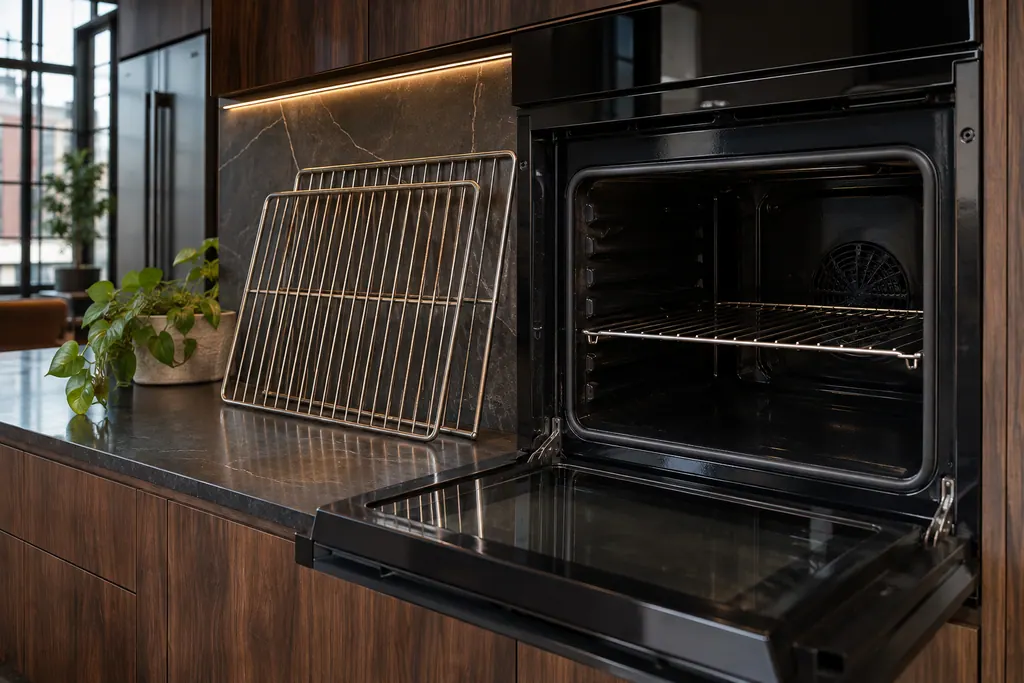
- Unused racks. Racks left inside add to the preheat time. Remove any you are not using. 123
- Door openings. Opening the door lets heat out, and repeated opening causes temperature swings that extend the preheat. 23
- Foil and liners. Do not cover a whole rack or the oven bottom with foil or non-stick baking liners, since that blocks airflow. 23
- Hidden bake element. It supplies buffered heat and takes longer than an exposed element. 13
- Bigger cavities. Current ovens are larger than older models, so they take longer. 13
- Cold room. A low or cold room temperature lengthens preheating. 1
The first two are in your hands. Take the racks out before you start, and wait for the tone.
Does 208V power slow the oven down?#
Yes. JennAir says a range or oven installed on 208V takes longer to preheat than one on 240V, and that performance is not affected once the set temperature is reached. 1 A building with an elevator is likely to have 208V, and the commercial-range page names that case. 3
You cannot change the voltage by yourself, and you should not try. The supply is part of the building's wiring, and an electrician decides what is possible. What you can do is plan for it: switch the oven on a few minutes earlier than you would elsewhere.
If you are unsure about your voltage, the rating plate and the installation instructions have it, and a technician can check it during a visit. Tell us the building type when you book.
Is a slow preheat different from a slow oven?#
Slow preheat and slow cooking are separate questions. A slow preheat means the cavity takes a long time to reach the set point. A slow oven usually means that the temperature drifts or the food cooks unevenly after reaching it. Treat them separately.
If food now takes longer than before, JennAir has separate help on cooking times after you replace an oven, and on uneven results. Our uneven baking guide covers pans, rack height and convection conversion.
An oven that reaches the preheat tone but then bakes unevenly belongs there, because that is a pan, rack and airflow question more than a heating one. An oven that never reaches the tone belongs on the oven temperature problems page and may need a technician.
Why does my new oven seem slower than my old one?#
Newer ovens have larger cavities, and a bigger cavity takes longer to fill with heat. JennAir's help page for cooking times after an oven replacement lists the same causes as for preheat: unused racks, a hidden bake element, a larger cavity, 208V power and a cold room. 4
The page also asks three questions about habits. Did you let the oven preheat? Did you put food in before the preheat tone? Did you open the door while it heated? 4 A new oven teaches a new rhythm, and the old one's timing no longer applies.
JennAir adds a tip for checking food: use the oven light, since opening the door lets heat out and cools the oven, and only open the door to check results once the minimum cooking time has been reached. 4
What is Rapid Pre-Heat?#
On select JennAir ovens, Rapid Pre-Heat is a faster preheating option. It uses all the oven elements together with a fan to get to temperature sooner and to create an ideal temperature for single-rack baking. JennAir says it saves time and energy. 1
Whether your model has it is a question for the owner's manual. If it does, it is worth using for single-rack bakes. For multiple racks, the ordinary preheat is the one to use, and the number of racks affects how long you wait. 1
What should I try before I call?#
Run one clean test preheat so you know what your oven really does.
- 1
- 2
- 3
- 4
Is a long preheat ever a repair issue?#
When the oven stays well beyond the normal times with a clean cavity and a closed door, or when it never reaches the preheat tone. JennAir's pages give no fixed cutoff, so we compare your measured time with the type of element, the cavity size and the supply.
You can read about the parts a technician checks in the bake and broil element and temperature sensor entries, or browse the oven repair service.
Sources#
- Long Pre-Heat Times for Oven - Product Help | JennAirJennAir Product Help (producthelp.jennair.com) · dateModified 2025-10-16; PH 693 · PH 693
- Long Preheat Times - Range - Product Help | JennAirJennAir Product Help (producthelp.jennair.com) · dateModified 2025-03-06; PH 12693 · PH 12693
- Long Pre-Heat Times - Commercial Range - Product Help | JennAirJennAir Product Help (producthelp.jennair.com) · dateModified 2025-10-01; PH 14025 · PH 14025
- Takes Less or More Time to Cook Than Previous Oven - Commercial Range - Product Help | JennAirJennAir Product Help (producthelp.jennair.com) · dateModified 2025-10-01; PH 14034 · PH 14034